
Table of Contents
For years, parents have worried about what children post online. Maybe it was oversharing personal information, talking to strangers, or posting embarrassing photos that might follow them into adulthood.
Now there’s a new concern that sounds almost unbelievable at first:
What if a simple selfie results in AI stealing fingerprints?
Not because your child willingly gave it away — but because modern AI tools may be able to reconstruct biometric details from ordinary photos posted online.
It sounds like science fiction. Unfortunately, researchers say it is becoming increasingly realistic.
And for parents already feeling uneasy about artificial intelligence, deepfakes, facial recognition, and the amount of personal data our children casually hand over online every day, this latest development raises an even bigger question:
Are we entering a world where nothing about our digital identity is truly private anymore?
This article isn’t meant to create panic. But it is meant to encourage awareness — especially for parents raising children in a culture where posting selfies, hand gestures, and high-resolution photos has become second nature.
Why This Story Is Getting So Much Attention
The recent headlines surrounding “AI stealing fingerprints from selfies” exploded online because they tap directly into a growing fear many people already have about artificial intelligence:
AI systems are becoming powerful enough to analyze details humans would never notice.
Researchers and cybersecurity experts have warned that certain high-resolution photos — especially selfies where fingers are clearly visible near the camera — may contain enough detail for AI enhancement software to reconstruct parts of a fingerprint.
In other words, those trendy peace-sign selfies or finger-pointing poses may reveal more than people realize.
Years ago, this kind of biometric extraction required advanced forensic tools and expert-level knowledge. Today, AI image enhancement has dramatically lowered the barrier.
Modern smartphones already use computational photography, sharpening, and detail enhancement automatically. AI systems can then further clean up and magnify images.
The result?
Details once too blurry to use may now become surprisingly readable.
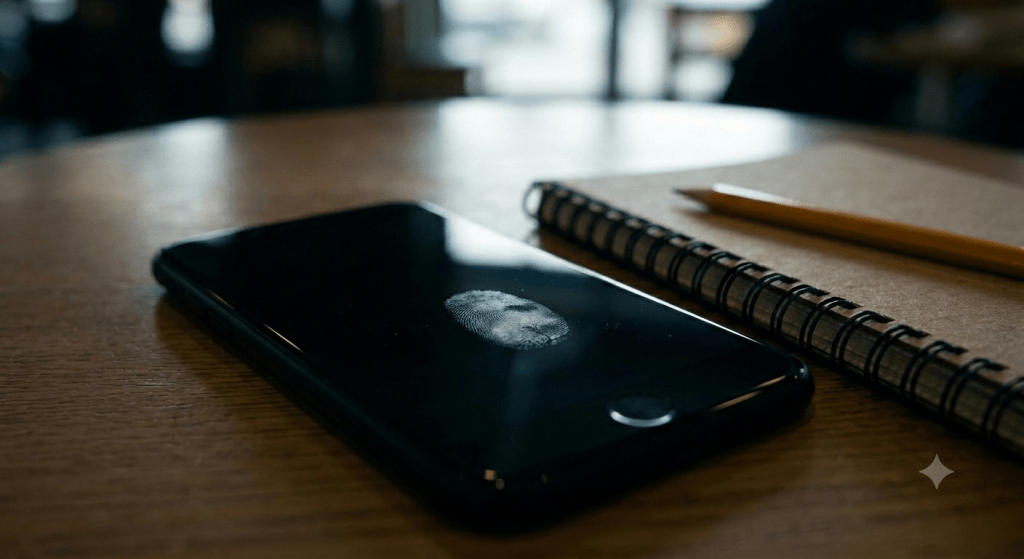
Wait… Can AI Really Steal Fingerprints From Photos?
The short answer is:
Potentially yes — under the right conditions.
But there’s important context parents should understand.
This is not currently something the average internet scammer is doing at scale. Most people are not having their fingerprints stolen from Instagram tomorrow morning.
However, researchers have repeatedly demonstrated that fingerprints can be reconstructed from photographs under certain conditions, especially when:
- The photo is high resolution
- Fingers are close to the camera
- Lighting is good
- The image has not been heavily compressed
- AI enhancement tools are used afterward
One cybersecurity researcher famously recreated fingerprints from public photos over a decade ago. Since then, AI image enhancement technology has become vastly more accessible.
What once required specialized labs can now be attempted with consumer software and AI-powered tools.
That’s the part making experts nervous.
Why Fingerprints Are Different From Passwords
Here’s what makes this issue especially unsettling:
If your password gets stolen, you can change it.
If your fingerprint gets compromised… you can’t exactly grow a new thumb.
Biometric data — fingerprints, facial scans, retina scans, voiceprints — are permanent parts of your identity.
That’s why security experts treat biometric leaks much more seriously than ordinary data breaches.
And unfortunately, we’ve already seen major biometric breaches happen before.
Massive Fingerprint Breaches Have Already Happened
While selfie-based fingerprint theft is still relatively niche, biometric databases themselves have already been compromised in major hacks.
Some of the most notable examples include:
- The 2015 U.S. Office of Personnel Management breach, which exposed fingerprints from over 5 million federal employees
- The 2019 Suprema security breach, which reportedly exposed over a million fingerprint records tied to security systems
These incidents weren’t caused by selfies — but they proved something important:
Biometric data is incredibly valuable to hackers.
And unlike passwords, compromised biometric data creates long-term risk.
Why Parents Should Care About This
Most children and teenagers today have grown up in a culture where posting photos online feels completely normal.
Peace signs.
Close-up selfies.
TikTok hand gestures.
Instagram aesthetic photos.
YouTube thumbnails.
Kids rarely think about what information those images might contain beyond what’s visible to the human eye.
But artificial intelligence doesn’t “see” photos the way humans do.
AI systems can analyze:
- Facial geometry
- Skin texture
- Finger ridge patterns
- Location metadata
- Objects in the background
- Reflections
- Device information
- Behavioral patterns
And increasingly, all of this data can be combined together.
For parents, this becomes another reminder that the internet is no longer simply a public scrapbook.
It’s a massive data collection environment.
The Bigger AI Problem: Deepfakes and Fake Images
At the exact same time researchers are warning about fingerprint exposure, another major AI concern is rapidly growing:
Deepfakes.
AI-generated images and videos are becoming shockingly realistic.
Today, AI can create:
- Fake celebrity photos
- Fake crime scenes
- Fake political videos
- Fake social media profiles
- Fake school incidents
- Fake explicit images
And increasingly, it’s becoming difficult to tell what’s real anymore.
Researchers from the University of Edinburgh recently found that even the “AI fingerprints” designed to identify AI-generated images can often be removed or manipulated.
That’s a major problem.
What Are “AI Fingerprints”?
AI-generated images often contain tiny invisible patterns left behind by the model that created them.
Researchers call these patterns “AI fingerprints.”
Think of them like subtle digital traces that investigators can use to determine whether an image came from ChatGPT, Midjourney, Stable Diffusion, or another AI system.
These fingerprints are supposed to help:
- Detect deepfakes
- Identify misinformation
- Trace fake images back to their source
- Hold bad actors accountable
But researchers found something alarming:
These AI fingerprints can often be weakened or erased with very simple edits.
Simple Edits Can “Smudge” AI Evidence
According to the University of Edinburgh study, even ordinary edits like:
- Cropping
- JPEG compression
- Resizing
- Slight blurring
…can interfere with AI fingerprint detection.
In some cases, researchers achieved fingerprint removal success rates above 80%.
That means fake AI-generated images may become even harder to track over time.
For parents, this matters because children and teens increasingly live in an online world where:
- Fake content spreads rapidly
- Deepfakes can damage reputations
- Cyberbullying is amplified
- Manipulated media feels real
And many kids simply are not emotionally prepared to navigate that environment.
The Psychological Side Parents Shouldn’t Ignore
One of the biggest concerns with AI-generated media is not merely technological.
It’s emotional and psychological.
Children already struggle with:
- Social comparison
- Anxiety
- Cyberbullying
- Unrealistic beauty standards
- Online manipulation
Now imagine a world where:
- Photos can’t be trusted
- Videos may be fake
- Voices can be cloned
- Images can be fabricated instantly
The line between reality and fabrication becomes blurrier every year.
For younger generations who already spend enormous amounts of time online, this can quietly erode:
- Trust
- Critical thinking
- Emotional security
- Confidence in truth itself
Many parents already feel overwhelmed trying to manage social media, YouTube, gaming, and screen addiction.
AI adds another layer of complexity most families aren’t prepared for.
The Real Danger Isn’t Just Hacking
When people hear stories about AI stealing fingerprints, they often imagine Hollywood-style hackers breaking into phones.
But the deeper concern may actually be cultural.
We are rapidly building a society where:
- Privacy is disappearing
- Personal data is constantly harvested
- AI systems analyze nearly everything
- Children normalize oversharing from a very young age
And many people don’t fully understand what they are giving away online.
That includes adults.
Most of us accepted facial recognition, cloud photo backups, smart assistants, and social media filters long before we fully understood how much data those systems were collecting.
Now AI is accelerating that process dramatically.

Practical Steps Parents Can Take Right Now
Parents do not need to panic or ban every piece of technology.
But families should become more intentional and aware.
Here are several practical steps worth considering.
1. Teach Children That Photos Contain More Data Than They Realize
Most kids think a photo is “just a picture.”
Explain that modern AI systems can analyze details humans barely notice.
This includes:
- Faces
- Backgrounds
- School logos
- Addresses
- Device data
- Potential biometric details
Digital literacy matters more than ever.
2. Avoid High-Resolution Finger-Forward Selfies
This may sound silly at first, but experts increasingly recommend avoiding:
- Close-up peace sign poses
- Finger-pointing selfies near the camera
- High-resolution fingertip images posted publicly
Especially for children and teenagers.
3. Use Multi-Factor Authentication
Never rely solely on fingerprints or face scans for sensitive accounts.
Whenever possible:
- Enable two-factor authentication
- Use strong passwords
- Add PIN backups
- Protect financial accounts carefully
Biometrics should be one layer — not the entire security system.
4. Delay Social Media Exposure
Many parents now regret giving unrestricted internet access too early.
The earlier children enter social media culture, the earlier they begin building permanent digital footprints they may not fully understand.
This is one reason many families are now:
- Delaying smartphones
- Limiting social media
- Doing “tech fasts”
- Creating screen-free environments
👉 You may also appreciate our review of The Tech Exit, which explores how reducing screen exposure can dramatically improve family life.
5. Teach Healthy Skepticism Online
Children increasingly need media literacy skills.
Teach them:
- Not every image is real
- Deepfakes exist
- AI-generated videos are spreading
- Online popularity does not equal truth
- Algorithms manipulate attention
Helping children think critically may become one of the most important parenting skills of the AI era.
AI Is Not All Bad — But Blind Trust Is Dangerous
It’s important to say this clearly:
Artificial intelligence itself is not inherently evil.
AI can:
- Help doctors detect diseases
- Improve accessibility tools
- Enhance education
- Assist with creativity
- Increase productivity
But like every major technology shift in history, it also creates new risks.
The concern many parents feel is not irrational fear.
It’s the realization that technology is evolving faster than society’s ability to process its consequences.
And children are often the first generation exposed to those consequences at scale.
A Personal Reflection as Parents
One of the strange things about modern parenting is that we are often expected to casually accept technologies that would have sounded dystopian just twenty years ago.
AI analyzing children’s faces.
Apps tracking behavior patterns.
Algorithms shaping attention spans.
Deepfakes altering reality.
Biometric data floating around online.
And somehow we’re supposed to treat all of this as normal.
Many parents already limit cigarettes, alcohol, or unsafe environments because the long-term dangers are obvious.
But with screens and AI systems, society often takes a far more relaxed approach — even as evidence grows that these technologies profoundly shape mental health, attention, relationships, identity, and privacy.
That doesn’t mean rejecting technology entirely.
But it probably does mean slowing down, asking harder questions, and becoming more intentional about what we normalize for our children.
Final Thoughts
The idea that AI could reconstruct fingerprints from selfies may sound extreme.
But even if the immediate practical risk remains relatively low for average families, the broader message is important:
We are entering an era where personal data — including biometric data — is more exposed, more valuable, and more vulnerable than ever before.
At the same time, AI-generated content is making it harder to know what’s real online.
For parents, this isn’t simply about fingerprint theft.
It’s about teaching children how to navigate a digital world that is becoming increasingly artificial, manipulative, and invasive.
And that conversation is only beginning.
Frequently Asked Questions (FAQ)
Can AI really steal fingerprints from selfies?
Under certain conditions, researchers have shown that high-resolution photos containing visible fingertips may allow AI tools to reconstruct portions of fingerprints. The risk is currently limited but increasingly possible as AI image enhancement improves.
How close does a hand need to be for fingerprints to be visible?
Experts suggest photos taken within several feet — especially with modern smartphone cameras and good lighting — may capture enough detail for AI enhancement software to analyze fingerprint ridges.
Should parents stop posting photos of their children online?
Not necessarily, but parents should become more cautious about public high-resolution images, especially close-up photos showing identifiable details like school uniforms, addresses, or visible fingerprints.
Can fingerprints be changed if stolen?
No. Unlike passwords, fingerprints are permanent biometric identifiers and cannot simply be replaced.
What are AI fingerprints in deepfakes?
AI fingerprints are hidden digital patterns left behind by AI image generators. Researchers use them to identify whether an image was created by artificial intelligence.
Can deepfake detection systems fail?
Yes. Researchers found that simple edits like resizing, compression, or blurring can weaken or erase many AI fingerprint detection systems.
What can parents do to protect children from AI-related privacy risks?
Parents can:
– Teach digital literacy
– Delay social media exposure
– Limit oversharing
– Use multi-factor authentication
– Discuss deepfakes and AI manipulation openly
– Encourage healthier screen habits